


Laguna Ritual Teas
Immune Defense Tea
Immune Defense Tea
Herbal support for immune function, seasonal wellness & daily resilience
Couldn't load pickup availability


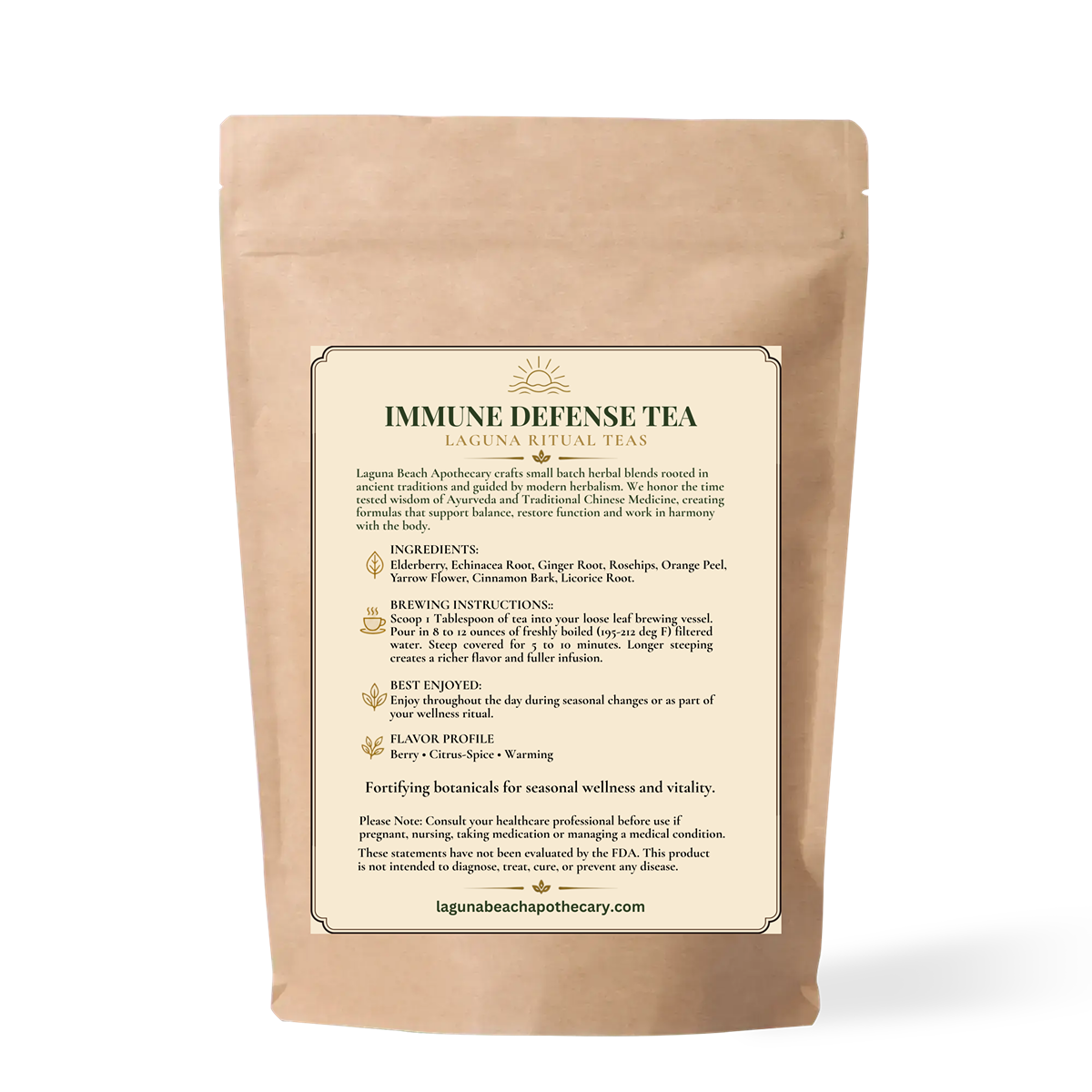

A Daily Herbal Ritual for Immune Support
The immune system is working quietly every day, responding to the world around us and helping the body maintain its natural balance. Seasonal changes, travel, busy schedules, changes in sleep, and the many demands of everyday life can all become part of that environment.
We created Immune Defense with that broader perspective in mind. Rather than thinking about immune support as something we turn to only when we feel run down, we wanted to create an immune support herbal tea that could become part of a consistent daily ritual—particularly during the changing seasons, when many of us naturally pay more attention to our health and resilience.
At the heart of the blend are elderberry and echinacea, two plants with long histories of traditional use in herbal practice. Ginger and cinnamon bring warmth and aromatic depth, while rosehips and orange peel contribute bright, naturally fruity notes. Yarrow and licorice add their own traditional botanical character, creating a formula that is both purposeful and enjoyable to drink.
Immune Defense brings together eight whole herbs traditionally associated with immune support, seasonal wellness, warmth, digestion, and resilience. The result is a caffeine-free herbal tea designed to become part of your everyday rhythm—not something reserved for a particular season or circumstance.
Our approach is simple: support the body's natural defenses while creating a tea you genuinely want to drink.
Enjoy it as part of your morning routine, alongside a quiet afternoon, or whenever the changing season calls for a little extra attention to your daily herbal ritual.
A thoughtful cup for supporting resilience, seasonal wellness, and the body's natural immune function.
Why These Herbs
Immune Defense brings together eight herbs with long histories of traditional use around immune function, seasonal wellness, respiratory support, digestion, and resilience. Each plant brings a different traditional quality to the formula, creating a blend designed to support the body's natural defenses while remaining suitable for everyday herbal use.
Elderberry forms the foundation of the blend. Traditionally used in European folk medicine for seasonal respiratory complaints, elderberry has become one of the best-known herbs associated with seasonal immune support. Its dark berries are rich in naturally occurring plant compounds, giving this botanical an important place in the formula.
Echinacea brings a long history of traditional use from North American herbal practice. Traditionally valued for its relationship to the body's natural immune defenses and respiratory system, echinacea became an important plant in Western herbalism. It gives Immune Defense a distinctly purposeful herbal character.
Ginger has been used across Asian, Middle Eastern, and European traditions for centuries. Traditionally valued for digestion, circulation, warmth, and respiratory comfort, ginger brings a broad range of traditional uses to the formula. Its warming nature also helps support the overall character of a seasonal herbal blend.
Rosehips add more than their naturally bright botanical character. Traditionally used in European herbal practice as a nourishing, vitamin-rich fruit, rosehips have long been valued for seasonal wellness and general nourishment. They bring another dimension of traditional support to the formula.
Orange Peel has a long history in both Western and Asian herbal traditions, particularly in preparations associated with digestion and respiratory comfort. Aromatic citrus peels have traditionally been used to help move and harmonize herbal formulas, making orange peel a natural companion to the deeper botanicals in Immune Defense.
Yarrow is a classic European medicinal herb with a long history of traditional use. Traditionally associated with circulation, digestion, seasonal wellness, and the body's natural response to changes in temperature, yarrow contributes a broad herbal perspective to the blend.
Cinnamon has been valued across traditional herbal systems for its warming, digestive, and circulatory qualities. Its traditional use extends across Asian, Middle Eastern, and European medicine, where it has long been incorporated into formulas intended to warm and support the body.
Licorice Root has one of the longest histories of use among the herbs in the formula, appearing in Chinese, Ayurvedic, Middle Eastern, and Western herbal traditions. Traditionally used to soothe and harmonize herbal formulas, licorice has also been associated with respiratory and digestive support. Its naturally sweet root makes it especially useful for bringing the other herbs together.
Together, these herbs create a formula with several complementary areas of traditional use. Elderberry and echinacea center the blend around seasonal and immune support. Ginger, yarrow, and cinnamon bring warming and digestive traditions. Rosehips and orange peel add nourishing and aromatic qualities, while licorice helps harmonize the formula and support the respiratory and digestive traditions of the blend.
The result is not a tea built around a single “immune herb,” but a broader herbal approach to supporting resilience and the body's natural defenses throughout the seasons.
Eight plants, each with a different traditional role, brought together in one thoughtful daily herbal ritual.
The Herbs
-

Elderberry
Immune Support • Seasonal Wellness • Traditional Respiratory Herb • Antioxidant-Rich
-

Echinacea
Immune Support • Traditional Herbalism • Respiratory Support • Botanical Resilience
-

Ginger Root
Digestive Support • Warming • Circulatory Tradition • Respiratory Comfort
-

Rosehips
Seasonal Wellness • Nourishing • Vitamin C Source • Antioxidant-Rich
-

Orange Peel
Digestive Support • Aromatic • Respiratory Comfort • Citrus-Rich
-

Yarrow
Traditional Herbalism • Digestive Support • Circulatory • Seasonal Wellness
-

Cinnamon Bark
Warming • Digestive Support • Circulatory Tradition • Aromatic
-

Licorice Root
Respiratory Support • Digestive Support • Harmonizing Herb • Traditional Adaptogen


The Cup
Immune Defense opens with the bright, naturally fruity character of elderberry and rosehips, followed by the fresh citrus notes of orange peel. Ginger and cinnamon bring gentle warmth and aromatic depth, giving the cup a comforting, rounded quality.
Beneath those brighter notes, yarrow adds a subtle herbal character while licorice root contributes a naturally sweet finish that helps bring the blend together. Echinacea adds a deeper botanical note, giving the infusion a distinctly herbal foundation without overpowering the brighter ingredients.
As the herbs come together, the cup moves from bright and fruity to warm, aromatic, and gently sweet, with a clean herbal finish.
The result is a full-bodied herbal infusion that feels especially natural during the changing seasons—bright enough for daytime, warming enough for cooler evenings, and interesting enough to become part of a regular daily ritual.
Fruity • Citrus • Warm • Aromatic • Herbal • Naturally Sweet • Spiced • Smooth
A Closer Look
How to Brew
Scoop 1 tablespoon of Immune Defense into your loose-leaf brewing vessel.
Pour 8–12 ounces of freshly boiled water over the herbs.
Steep covered for 10–20 minutes, or longer.
The blend contains berries, roots, bark, aromatic peel, and leafy herbs, so a covered, longer infusion allows the different botanicals to infuse fully while helping preserve their more delicate aromatic qualities.
Strain and enjoy warm.
As an herbal infusion rather than traditional tea, it can be steeped longer according to your preference.
For a deeper, more concentrated infusion, steep for 15–20 minutes or even longer. A longer steep will bring out more of the berry, root, bark, and herbal character while creating a fuller-bodied cup.
One tablespoon • 8–12 oz water • 10–20+ minute steep
When to Enjoy
Immune Defense is designed to become part of your everyday herbal routine, particularly during seasonal changes or times when you want to give a little more attention to immune support.
Try a cup in the morning or early afternoon, when its warming ginger, cinnamon, and bright citrus character can fit naturally into the day. It also makes a comforting cup later in the afternoon, especially during cooler weather or when you're settling into a quieter part of the day.
You can enjoy it on its own or alongside a meal. The blend's ginger, orange peel, yarrow, and licorice also make it a natural companion to digestion.
Rather than saving an immune support tea for the first sign of feeling run down, consider making it part of a consistent seasonal ritual.
A warm, flavorful herbal ritual for supporting resilience through the changing seasons.
Ingredients
Elderberry — Sambucus nigra
Berry • Seasonal & respiratory support
The deep purple-black fruit of the elder tree, traditionally harvested when ripe and prepared as teas, syrups, and other herbal preparations. Elderberry has a long history in European herbalism and brings a rich berry character to the blend.
Echinacea — Echinacea purpurea
Herb & root • Immune & respiratory support
A striking North American native with pink-purple flowers and a long history in Western herbalism. Traditionally used in preparations centered around the body's natural defenses and respiratory system, echinacea gives the blend a distinctive botanical character.
Ginger Root — Zingiber officinale
Rhizome • Digestive & warming support
The aromatic underground rhizome of the ginger plant, ginger has traveled through Asian, Middle Eastern, and European herbal traditions for centuries. Traditionally valued for digestion, warmth, circulation, and respiratory comfort, its pungent character brings depth to the formula.
Rosehips — Rosa spp.
Fruit • Nourishing & seasonal support
The small red fruits that develop after the rose flower fades, rosehips have traditionally been gathered as a nourishing seasonal fruit. Naturally rich in vitamin C and other plant compounds, they contribute a bright, tart botanical character to the blend.
Orange Peel — Citrus sinensis
Peel • Digestive & aromatic support
The fragrant outer peel of the sweet orange, traditionally used in both Western and Asian herbal preparations. Its aromatic oils and naturally bright character make it a classic companion to deeper, warming botanicals.
Yarrow — Achillea millefolium
Flowering herb • Digestive & circulatory support
A hardy flowering plant found throughout much of the Northern Hemisphere, yarrow is recognizable by its finely divided leaves and clusters of small flowers. A familiar plant in European herbal traditions, it has traditionally been used around digestion, circulation, and seasonal herbal preparations.
Cinnamon Bark — Cinnamomum verum
Bark • Warming & digestive support
The fragrant inner bark of the cinnamon tree, traditionally harvested, dried, and rolled into quills. Valued across Asian, Middle Eastern, and European traditions, cinnamon brings warming aromatic qualities and has long been associated with digestive support.
Licorice Root — Glycyrrhiza glabra
Root • Respiratory & digestive support
The naturally sweet root of a perennial legume native to parts of Europe and Asia. Licorice has an exceptionally long history in traditional herbal practice, where it has been used for respiratory and digestive support as well as to harmonize and soften herbal formulas.
Caffeine
Naturally caffeine-free.
Immune Defense is made entirely from elderberry, echinacea, ginger, rosehips, orange peel, yarrow, cinnamon bark, and licorice root—none of these herbs naturally contain caffeine.
That makes it easy to enjoy throughout the day, from a morning cup to an afternoon ritual or a warm evening infusion.
Caffeine-free • Whole-herb infusion • Naturally warming
Flavor & Aroma
Immune Defense has a bright, warming character, beginning with the fruity depth of elderberry and the fresh citrus aroma of orange peel and rosehips.
Ginger and cinnamon bring gentle spice and warmth to the middle of the cup, while yarrow and echinacea add a distinctly herbal layer beneath the brighter fruit and citrus notes.
Licorice root rounds everything out with a subtle natural sweetness, softening the sharper herbal notes and giving the infusion a smooth, lingering finish.
The overall character is fruity, citrusy, warmly spiced, herbal, and naturally sweet—a full-bodied cup with enough brightness to remain refreshing while the deeper botanicals give it a comforting, grounded quality.
Fruity • Citrus • Warm • Spiced • Herbal • Naturally Sweet • Full-Bodied • Smooth
Herbal Research
Immune Defense brings together eight herbs with long histories of traditional use around seasonal wellness, respiratory comfort, digestion, and the body's natural defenses. Many of these same plants have attracted significant attention in modern research, and some of the findings are especially interesting when we look at the formula as a whole.
Elderberry is one of the best-known botanicals in the formula for seasonal respiratory support. Human clinical research has investigated black elderberry in relation to upper-respiratory symptoms, and a meta-analysis of randomized controlled trials found that elderberry supplementation was associated with substantial reductions in upper-respiratory symptoms. A broader systematic review also found promising evidence around reducing the duration and severity of respiratory illness.
Researchers are particularly interested in elderberry's naturally occurring anthocyanins and other polyphenols. These compounds have demonstrated antioxidant and biological activity in laboratory research, helping explain why this dark berry has become such an important plant in modern seasonal herbal products.
Echinacea has one of the largest bodies of research among traditional immune herbs. Human studies have explored its relationship to upper-respiratory infections, immune response, and cold symptoms. A 2019 systematic review and meta-analysis found that echinacea preparations were associated with a lower incidence of upper-respiratory infections, although the authors noted that the clinical importance of the effect remains open to discussion.
There is also a particularly interesting piece of research for us because it involved an echinacea compound herbal tea rather than only capsules or isolated extracts. In that randomized, double-blind, placebo-controlled study, participants taking the echinacea tea after the onset of cold or flu symptoms experienced shorter and less severe symptoms than the placebo group.
Ginger brings an enormous research history to the formula. A comprehensive review identified more than 100 randomized controlled trials investigating ginger across a wide range of applications. Some of the strongest areas of interest include nausea and digestive function, while other research has examined inflammation, metabolic health, and other physiological processes.
That breadth is consistent with ginger's remarkably broad traditional history. It has been used for centuries across Asian, Middle Eastern, and European herbal traditions, particularly around digestion, warmth, circulation, and respiratory comfort.
Rosehips contribute a different kind of botanical richness. These bright fruits contain vitamin C along with carotenoids, flavonoids, phenolic compounds, and other naturally occurring constituents. Research has explored their antioxidant and anti-inflammatory properties, while human clinical research has shown particular interest in concentrated rosehip preparations and joint health.
For an herbal formula, rosehips are interesting because they combine nutritional value with a broad spectrum of naturally occurring plant compounds, rather than being valued for a single constituent.
Orange peel contains a concentrated collection of citrus flavonoids and aromatic compounds, including naturally occurring essential oils. Research into Citrus sinensis has identified antioxidant and other biological activities associated with its phytochemicals.
Traditional herbalists have long appreciated something modern chemistry is now able to describe in much greater detail: the peel is an active and aromatic part of the citrus fruit, not simply something to discard. In Immune Defense, it brings both its traditional digestive role and its rich collection of citrus compounds.
Yarrow has an especially interesting place between traditional herbalism and modern research. Its flowers and leaves contain flavonoids, sesquiterpenes, essential oils, and other constituents that have been investigated for antioxidant, anti-inflammatory, digestive, and other biological activities.
Yarrow's long European herbal history is particularly notable because many of the traditional applications that made it valuable to herbalists are now being explored through modern studies of its chemistry and biological activity.
Cinnamon is another extensively researched botanical, although its modern research profile extends well beyond seasonal wellness. Human studies and reviews have investigated cinnamon in areas including blood sugar regulation, metabolic health, inflammation, and cardiovascular markers.
This makes cinnamon an interesting supporting herb in Immune Defense. Its traditional warming and digestive qualities are accompanied by a substantial modern research history, giving this familiar spice a surprisingly deep botanical profile.
Licorice root has perhaps the longest history of medicinal use in the formula. Its principal constituents, including glycyrrhizin and numerous flavonoids, have been studied extensively for antioxidant, inflammatory, respiratory, and other biological activities.
Licorice is particularly interesting because it appears to have a dual role in traditional formulas: it is valued for its own respiratory and digestive properties while also being used as a harmonizing herb, helping bring other botanicals together. Modern research into its constituents provides another window into this remarkably versatile root.
What I find most interesting about Immune Defense is that the research doesn't point to one “immune herb” doing everything. The formula brings together plants with different areas of research and different traditional roles.
Elderberry and echinacea have attracted the most direct attention around seasonal respiratory and immune support. Ginger contributes a substantial body of digestive and anti-inflammatory research. Rosehips bring vitamin C and a broad range of polyphenols and carotenoids. Orange peel contributes citrus flavonoids and aromatic compounds. Yarrow and cinnamon add their own extensive traditional and pharmacological histories, while licorice brings centuries of respiratory and digestive use alongside modern research into its complex chemistry.
Much of the modern research uses concentrated extracts or standardized preparations, while Immune Defense is made from whole herbs brewed as an infusion. The two preparations aren't identical, but the research gives us valuable insight into the plants themselves and the remarkable chemistry contained within them.
Traditional herbal knowledge gives us centuries of experience with these plants. Modern research gives us another way to understand their constituents, biological activity, and potential.
Immune Defense brings those two perspectives together in one whole-herb infusion—eight botanicals, each with its own history and character, thoughtfully combined into a daily ritual for seasonal wellness and natural resilience.
The Whole Herb
Modern botanical research often begins by identifying individual compounds within a plant and asking what those compounds do. That work has given us remarkable insight into herbs such as peppermint, lemon balm, gotu kola, schisandra, ginkgo, eleuthero, and licorice.
But a plant is more than any one of its constituents.
A peppermint leaf contains far more than menthol. Schisandra fruit contains a complex mixture of lignans, organic acids, aromatic compounds, and other naturally occurring constituents. Ginkgo, lemon balm, and gotu kola are equally intricate, each containing families of compounds that exist together within the plant.
When we prepare whole herbs as an infusion, we are working with that natural complexity rather than selecting a single isolated compound to represent the plant.
That distinction is especially meaningful in a formula like Brain Clarity. No single constituent—and no single herb—is being asked to define what mental clarity should look like. Leaves, roots, and berries with different botanical profiles are brought together, each contributing something different to the character of the infusion.
This is one of the enduring ideas behind traditional herbalism: the value of a plant is not always found in reducing it to one component or one purpose.
Whole herbs allow us to approach plants as they exist in nature—complex, multifaceted, and containing relationships between constituents that botanical science continues to explore.
Brain Clarity follows that philosophy. Seven whole botanicals, thoughtfully combined and prepared as a simple daily infusion.
Traditional Use
Long before the language of cognitive performance, neurotransmitters, or stress physiology existed, herbal traditions had their own ways of thinking about the mind.
Rather than separating memory, concentration, mood, digestion, energy, and resilience into entirely different categories, traditional herbal systems often viewed them as interconnected. A clear mind was understood in the context of the whole person.
Brain Clarity brings together plants from several of those traditions.
Gotu kola has a particularly deep relationship with the mind. Known as mandukaparni in Ayurveda, it has traditionally been used as a medhya rasayana—a category of restorative herbs associated with memory, intellect, and mental vitality.
Schisandra has a long history in Traditional Chinese Medicine, where the fruit is known as wu wei zi, or “five-flavor fruit.” Traditionally regarded as a strengthening and conserving herb, it was used in formulas associated with vitality, endurance, and maintaining balance during periods of demand.
Ginkgo comes from one of the oldest surviving tree species on Earth. Its leaves have a history of use in Chinese herbal practice, while its modern association with memory developed much later as European phytotherapy began studying standardized preparations of the leaf.
Eleuthero also comes from the herbal traditions of East Asia, where the root has been valued as a strengthening tonic. Its traditional identity centered less on creating immediate stimulation and more on supporting stamina and resilience over time.
European herbal traditions bring another dimension to the formula. Lemon balm was traditionally valued as a calming, uplifting aromatic herb, while peppermint became widely used for its refreshing character and its relationship with digestion and the senses.
And then there is licorice root—a plant with an unusually broad history across both Eastern and Western herbal traditions. Beyond its own traditional uses, licorice has often been included in multi-herb formulas to soften, balance, and harmonize the character of other plants.
Seen through this traditional lens, Brain Clarity begins to look less like a collection of individual “brain herbs” and more like something herbalists have understood for generations:
The mind does not exist separately from the rest of the body.
Clarity can be approached through calm as well as stimulation, through resilience as well as concentration, and through consistent nourishment rather than waiting until mental energy feels depleted.
Brain Clarity carries that older herbal philosophy into a modern daily ritual—seven plants from different traditions, brought together around the simple practice of caring for the mind.