


Laguna Ritual Teas
Golden Balance Tea
Golden Balance Tea
Herbal support for inflammatory balance, digestion & everyday resilience
Couldn't load pickup availability


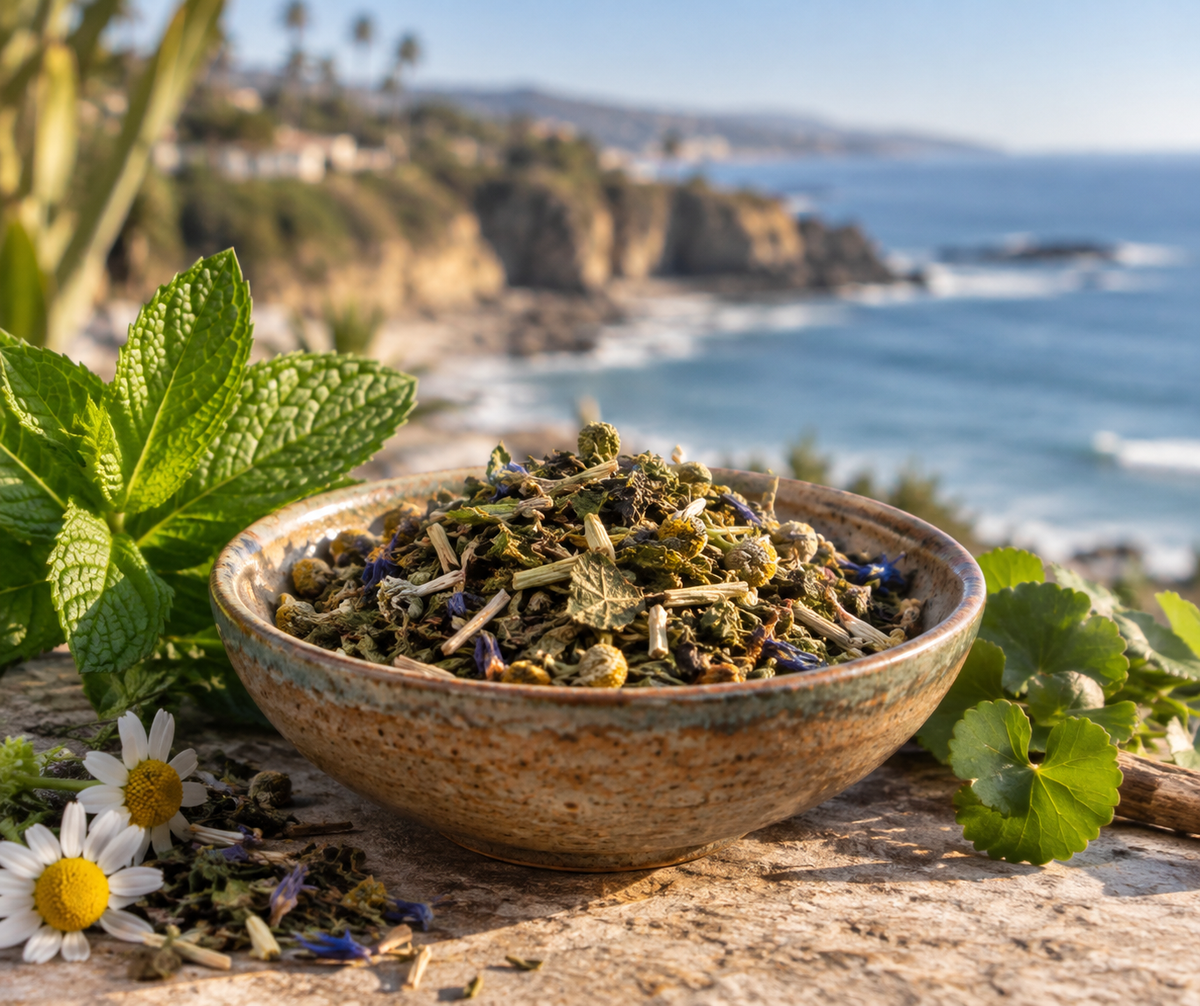


When your body needs to find its balance
Golden Balance was created around the simple idea that balance is something we cultivate, not something we chase.
Turmeric, ginger, Ceylon cinnamon, fennel, orange peel, licorice, and black pepper bring together warming roots, aromatic spices, and traditionally valued botanicals that have been part of herbal and culinary traditions around the world for generations.
Each brings something different to the formula. Turmeric has a long traditional relationship with inflammatory balance and digestion, while ginger and Ceylon cinnamon bring warming qualities traditionally associated with digestion and circulation. Fennel and orange peel contribute their own long relationship with digestive function, and licorice brings soothing qualities along with its traditional role as a harmonizing herb.
Black pepper completes the formula with more than heat. Its naturally occurring piperine has attracted considerable research interest for its ability to influence the bioavailability of certain botanical compounds, including curcumin from turmeric—giving the pairing of turmeric and black pepper a particularly interesting place in modern botanical research.
Together, these seven herbs create a warming herbal tea built around plants traditionally associated with digestion, circulation, inflammatory balance, and everyday resilience.
But Golden Balance is also built around a larger idea.
Rather than thinking of balance as something that needs to be corrected from the outside, we see it as part of the body's ongoing work. Food, movement, sleep, stress, digestion, and the plants we bring into our daily lives can all become part of that larger rhythm.
Golden Balance is a warm, grounding tea designed to become part of that rhythm—a simple daily ritual built around remarkable plants and the idea that small practices can add up over time.
Why These Herbs
Golden Balance brings together seven herbs with complementary relationships to inflammatory balance, digestion, circulation, and everyday resilience.
Turmeric sits at the center of the formula, bringing its long traditional relationship with inflammatory balance, digestion, and overall vitality.
Ginger and Ceylon cinnamon bring warmth and movement. Both have long traditions of use around digestion and circulation, giving the formula a warming foundation that extends beyond simply creating the flavor of the cup.
Fennel and orange peel bring another side of digestive herbalism. Their aromatic qualities have traditionally made them natural companions in digestive formulas, adding a brighter, lighter dimension alongside the deeper roots and spices.
Licorice root contributes gentle natural sweetness and soothing qualities while serving its traditional role as a harmonizing herb—helping bring together plants with very different flavors and botanical personalities.
Black pepper completes the formula with warmth and pungency. Its pairing with turmeric is intentional, bringing another traditional digestive spice into the blend while creating a botanical partnership that has also become particularly interesting to modern researchers.
Together, these seven herbs approach balance from several directions—combining warming roots and spices, aromatic digestive herbs, soothing botanicals, and plants traditionally valued for supporting the body's natural processes.
Each plant has a role, and the formula is designed around the way those qualities come together.
The Herbs
-

Turmeric Root
Inflammatory Balance • Digestive Support • Antioxidant Support • Restorative Tonic
-

Ginger Root
Warming • Circulatory Support • Digestive Support • Invigorating
-

Orange Peel
Aromatic Bitter • Digestive Support • Antioxidant Support • Uplifting Aromatic
-

Ceylon Cinnamon Bark
Warming • Circulatory Support • Antioxidant Support • Aromatic Spice
-

Fennel Seed
Digestive Comfort • Carminative • Soothing • Aromatic
-

Licorice Root
Anti Inflammatory • Restorative Tonic •Adaptogenic Support • Formula Harmonization
-

Black Peppercorn
Warming • Circulatory Support • Bioavailability Support • Invigorating


The Cup
Golden Balance opens with the warm, familiar aroma of Ceylon cinnamon and ginger, followed by the bright citrus character of orange peel. Turmeric gives the infusion its beautiful golden color and adds a subtle earthy depth beneath the brighter notes.
The first sip is warming without being hot or sharp. Cinnamon and ginger create a gentle spice, while fennel brings a soft sweetness and distinctly aromatic quality. Orange peel lifts the cup with a light citrus note, and licorice adds a smooth natural sweetness that rounds the deeper roots and spices.
Black peppercorn adds just enough warmth and pungency to give the finish some character without overpowering the other herbs.
As the tea settles, the brighter citrus and aromatic notes give way to the deeper character of the roots and spices, leaving a smooth, lingering warmth.
The longer the tea steeps, the fuller and more developed the cup becomes. It is a grounding tea to return to throughout the day—warming, aromatic, and deeply rooted in the character of the plants themselves.
Warm • Golden • Aromatic • Gently Spiced • Grounding
A Closer Look
How to Brew
Scoop 1 tablespoon of Golden Balance Herbal Tea into your loose-leaf brewing vessel.
Pour 8–12 ounces of freshly boiled, filtered water (195–212°F) over the herbs.
Steep covered for 15–20 minutes.
Golden Balance is built primarily from roots, bark, peel, seeds, and spices. A longer, covered infusion gives these denser botanicals time to steep while helping retain the aromatic qualities of ginger, Ceylon cinnamon, fennel, orange peel, and black pepper.
Strain and enjoy warm.
For a lighter, more aromatic cup, stay toward the shorter end of the steeping time. For a deeper, fuller-bodied infusion, allow it to steep a little longer, giving the roots, bark, peel, seeds, and spices more time to release their naturally occurring botanical constituents into the water.
One tablespoon • 8–12 oz water • 15–20 minute steep
When to Enjoy
Golden Balance is especially satisfying when you want something warm, grounding, and gently spiced.
Enjoy a cup in the morning, alongside or after a meal, during the afternoon, or whenever the warmth of turmeric, ginger, Ceylon cinnamon, and black pepper sounds particularly inviting.
Its deeper root-and-spice character also makes it a natural choice on cooler days, when a lighter herbal tea may not be what you're looking for. And because Golden Balance is naturally caffeine-free, it can be enjoyed later in the day without adding another source of caffeine.
There is no single right time for Golden Balance. Let the cup find its place naturally—sometimes alongside food, sometimes during a break in the day, and sometimes simply because something warm and grounding feels right.
Ingredients
Turmeric Root — Curcuma longa — Rhizome
A deeply valued botanical in Ayurvedic and other traditional herbal practices, traditionally associated with inflammatory balance, digestion, circulation, and overall vitality.
Ginger Root — Zingiber officinale — Rhizome
A warming, aromatic botanical traditionally valued for digestion, circulation, and its invigorating qualities.
Orange Peel — Citrus sinensis — Peel
An aromatic citrus peel traditionally used in digestive formulas for its gently bitter character and relationship with digestion.
Ceylon Cinnamon Bark — Cinnamomum verum — Bark
A warming aromatic spice traditionally valued for digestion, circulation, and maintaining warmth and vitality.
Fennel Seed — Foeniculum vulgare — Fruit
An aromatic botanical traditionally valued for digestive comfort and its carminative qualities.
Licorice Root — Glycyrrhiza glabra — Root
A naturally sweet, soothing root traditionally valued for digestive and restorative support and widely used as a harmonizing herb in herbal formulas.
Black Peppercorn — Piper nigrum — Fruit
A warming, pungent spice traditionally valued for digestion and circulation, with a long history of use alongside other botanicals in traditional formulas.
Caffeine
Naturally caffeine-free.
Golden Balance contains no caffeinated tea leaves or other naturally caffeinated ingredients.
Its warming combination of turmeric, ginger, Ceylon cinnamon, orange peel, fennel, licorice, and black pepper gives the tea a lively, warming character without relying on caffeine.
Golden Balance was intentionally formulated without caffeine, making it an easy choice throughout the day whenever you want something warm, aromatic, and gently spiced without adding another source of caffeine to your routine.
Caffeine-Free • Warming • Naturally Inviting
Flavor & Aroma
Warm ginger and Ceylon cinnamon lead the aroma, followed by the bright citrus character of orange peel. Turmeric brings a deeper earthy note to the cup, while fennel adds a gentle aromatic sweetness and licorice softens and rounds the blend.
Black pepper appears subtly in the finish, adding a light pungency and lingering warmth without overpowering the other spices.
Warm • Spiced • Citrus-Bright • Aromatic • Earthy • Gently Sweet
Herbal Research
Golden Balance brings together plants that have become increasingly interesting to modern researchers for many of the same broad areas that made them important in traditional herbal practice: inflammatory balance, antioxidant activity, digestion, circulation, and metabolic health.
Turmeric and ginger have received especially substantial research attention, while Ceylon cinnamon, fennel, orange peel, licorice, and black pepper each contribute their own distinctive plant chemistry.
One of the most interesting things about this formula is how much modern research is beginning to reveal about plants that people have been using for generations.
Turmeric — Curcuma longa
Few traditional herbs have attracted as much modern scientific attention as turmeric.
Much of that interest centers on the curcuminoids—particularly curcumin—and their relationship with inflammatory signaling and oxidative stress. Human clinical trials and large research reviews have investigated turmeric and curcumin across a remarkably broad range of areas, including inflammatory biomarkers, metabolic health, joint health, and antioxidant status.
Recent analyses bringing together dozens of randomized controlled trials have reported meaningful changes in several markers associated with inflammatory and oxidative balance, including CRP, TNF-α, IL-6, total antioxidant capacity, and malondialdehyde.
The science surrounding turmeric continues to evolve, but the scale of research devoted to this ancient botanical is remarkable.
Ginger — Zingiber officinale
Ginger has developed an equally interesting modern research story.
Its characteristic compounds—including gingerols and shogaols—have been studied for their relationship with inflammatory signaling, oxidative stress, digestion, and gastrointestinal function.
Human research is particularly well established around nausea, but clinical trials have also explored ginger's influence on inflammatory markers such as CRP and TNF-α and on several measures of oxidative balance.
This broader research fits naturally with ginger's traditional identity as a warming, moving botanical associated with digestion, circulation, and vitality.
Ceylon Cinnamon — Cinnamomum verum
Cinnamon contains an impressive range of polyphenols and aromatic compounds that have drawn research interest for their antioxidant activity and relationship with inflammatory and metabolic pathways.
Randomized clinical trials and subsequent meta-analyses have examined cinnamon supplementation in connection with inflammatory markers, oxidative stress, blood pressure, blood glucose regulation, and other measures of cardiometabolic health.
Cinnamon research sometimes includes several different species and preparations, making the botanical identity important when interpreting individual studies. Golden Balance specifically uses Ceylon cinnamon — Cinnamomum verum.
Its presence in the formula brings together two sides of the plant: the warming aromatic spice known to traditional herbalism and the chemically complex botanical increasingly investigated by modern science.
Fennel — Foeniculum vulgare
Fennel's distinctive aroma comes largely from its volatile oils, particularly anethole.
Researchers have investigated fennel and its constituents for antioxidant and inflammatory activity as well as their interaction with gastrointestinal smooth muscle—an intriguing modern counterpart to fennel's centuries-old reputation as a carminative digestive herb.
Fennel brings a lighter botanical character to Golden Balance while contributing its own distinctive chemistry to the formula.
Orange Peel — Citrus sinensis
Orange peel is considerably more chemically interesting than its familiar aroma might suggest.
Citrus peel contains flavonoids and other naturally occurring compounds, including hesperidin, that have become the subject of substantial research into antioxidant activity, inflammatory signaling, vascular function, and metabolic health.
Human clinical research on hesperidin continues to grow, while laboratory research has explored a much wider range of citrus compounds and biological pathways.
In Golden Balance, orange peel contributes both its bright aromatic character and the complex flavonoid chemistry naturally present in the peel.
Licorice — Glycyrrhiza glabra
Licorice contains a diverse collection of naturally occurring compounds, including glycyrrhizin, glycyrrhetinic acid, flavonoids, and polysaccharides.
Modern research has investigated these constituents in connection with inflammatory pathways, oxidative stress, gastrointestinal tissues, and cellular protection.
That chemistry gives another dimension to an herb traditionally valued not only for its soothing qualities, but for its remarkable ability to bring very different plants together within a formula.
Black Pepper — Piper nigrum
Black pepper may be present in a relatively small amount, but it has one of the most fascinating roles in Golden Balance.
Much of the research interest centers on piperine, the naturally occurring compound responsible for much of black pepper's characteristic pungency.
Piperine has been studied for antioxidant and inflammatory activity, but it is particularly well known for its ability to influence the absorption and metabolism of other botanical compounds.
This becomes especially interesting when black pepper is paired with turmeric.
Human pharmacokinetic research has demonstrated that piperine can substantially increase the bioavailability of curcumin under specific study conditions. That relationship has made the turmeric–black pepper pairing an important area of modern botanical research.
It is a fascinating example of something herbal formulation has long encouraged us to consider: sometimes the relationship between plants can be just as interesting as the plants themselves.
The Formula as a Whole
Golden Balance is built around more than one pathway or one botanical compound.
Turmeric and ginger provide a deeply researched foundation associated with inflammatory and oxidative balance. Ceylon cinnamon contributes its polyphenol-rich chemistry and warming character. Orange peel brings citrus flavonoids. Fennel contributes aromatic volatile oils. Licorice adds its complex collection of triterpenes, flavonoids, and polysaccharides. Black pepper contributes piperine and an especially interesting relationship with turmeric.
These are very different plants.
And that is precisely the point.
Inflammation itself is not something the body simply needs to eliminate. It is part of normal physiology—one of the ways the body responds, protects, repairs, and adapts. The more interesting question is how the body maintains balance within those processes.
That idea sits at the center of Golden Balance.
Modern research often studies individual compounds, standardized extracts, powders, or concentrated preparations because that allows researchers to measure particular effects with precision. Traditional herbal practice gives us another perspective: look at the whole plant, understand its character, and then consider what happens when different plants are brought together.
Golden Balance lives between those two ways of looking at herbs.
The research helps us understand curcuminoids, gingerols, polyphenols, citrus flavonoids, anethole, glycyrrhizin, piperine, and the many biological pathways researchers continue to investigate.
Traditional herbalism reminds us that people were working with turmeric, ginger, cinnamon, fennel, citrus peel, licorice, and black pepper long before any of those compounds had names.
Every herb in Golden Balance has a reason for being here. Together, they create a formula centered on warmth, resilience, inflammatory balance, and the remarkable chemistry of plants.
The Whole Herb
There is a reason we work with whole herbs rather than reducing a plant to a single isolated compound.
A plant contains an extraordinary collection of naturally occurring constituents that exist together within it. Modern research can isolate individual compounds and study them closely, giving us remarkable insight into plant chemistry and the ways particular constituents interact with biological systems.
But every compound begins as part of something larger.
Turmeric is a wonderful example. Curcumin has become so closely associated with turmeric that the two are sometimes spoken about almost interchangeably. Yet turmeric is not curcumin. The rhizome contains curcuminoids alongside volatile oils, polysaccharides, proteins, minerals, and many other naturally occurring constituents that together make up the plant.
The same is true throughout Golden Balance.
Ginger contains gingerols and shogaols, but those compounds are only part of the chemistry of the rhizome. Ceylon cinnamon contains aromatic oils and polyphenols. Orange peel carries citrus flavonoids and volatile compounds. Fennel brings its distinctive aromatic oils. Licorice contains triterpenes, flavonoids, and polysaccharides. Black pepper brings piperine alongside many other naturally occurring constituents.
Each plant is chemically intricate in its own right.
And then we bring seven of them together.
That is where herbal formulation becomes especially interesting.
A thoughtful herbal formula is not simply a collection of ingredients. It is a conversation between plants.
Turmeric provides the deep, earthy foundation. Ginger, Ceylon cinnamon, and black pepper bring warmth and pungency. Orange peel and fennel lift the formula with brighter aromatic qualities, while licorice softens and helps bring those very different botanical personalities together.
None of these plants needs to do everything on its own.
Traditional herbalists have worked with this idea for generations—learning the character of individual plants and then considering what changes when they are combined. Some herbs lead a formula. Some support it. Some soften its edges. Others bring contrast, movement, warmth, bitterness, sweetness, or aroma.
Modern botanical science gives us increasingly sophisticated ways to understand the chemistry inside these plants. Traditional herbalism reminds us not to lose sight of the plant itself.
Golden Balance lives at the meeting point of those two perspectives.
There is more to a plant than any single chemical within it.
We work with whole herbs because we value that complexity—and because there is still so much to discover about the remarkable plants that have accompanied people throughout human history.
Traditional Use
The herbs in Golden Balance come from several long-standing traditions of herbal practice, including Ayurveda, Traditional Chinese Medicine, Western herbalism, and traditional plant practices across Asia, the Middle East, and the Mediterranean.
Long before inflammation, oxidative stress, circulation, or metabolism could be measured in a laboratory, traditional herbal systems had developed their own ways of thinking about balance within the body.
Plants were understood through qualities such as warming and cooling, moistening and drying, stimulating and soothing, bitter and sweet. Herbalists paid attention not only to what a plant was used for, but to its taste, aroma, energetics, preparation, and the way it interacted with other herbs within a formula.
Golden Balance draws from that older way of thinking.
Turmeric has deep roots in Ayurveda and South Asian traditions, where it has been valued for centuries in connection with digestion, vitality, purification, and maintaining balance within the body. In Traditional Chinese Medicine, turmeric also developed its own identity and is known as jiang huang.
Ginger has traveled through herbal traditions across much of the world. Ayurveda and Traditional Chinese Medicine have long valued its warming character, while Western herbalists incorporated ginger into preparations associated with digestion, circulation, warmth, and vitality.
Ceylon cinnamon carries an equally rich history. Cinnamon has been traded and valued for thousands of years, becoming part of herbal and culinary traditions across South Asia, the Middle East, Europe, and beyond. Its warmth, sweetness, and aromatic character made it a natural companion to other warming herbs and spices.
Fennel has been part of Mediterranean, European, Middle Eastern, and Ayurvedic traditions for generations. Its aromatic fruits—commonly called seeds—have long been enjoyed around meals and incorporated into formulas centered on digestion and digestive comfort.
Orange peel represents another enduring herbal tradition: making use of the aromatic and bitter qualities concentrated in the peel of the fruit. Citrus peels have been incorporated into Chinese, European, and other herbal traditions, where their fragrance, bitterness, and distinctive character gave them a place in both simple preparations and more complex formulas.
Licorice root is one of the great harmonizing herbs of traditional herbal medicine. It appears across Chinese, Ayurvedic, Middle Eastern, and Western traditions, valued for its naturally sweet and soothing character as well as its ability to bring very different herbs together within a formula.
Black pepper has a particularly deep history in South Asian medicine and Ayurveda. Its pungent, warming character gave it an important place in traditional formulas, where spices were valued not merely for flavor but for the qualities they brought to digestion, warmth, movement, and the overall character of a preparation.
These traditions developed long before laboratories could identify curcuminoids, gingerols, polyphenols, volatile oils, flavonoids, glycyrrhizin, or piperine.
Herbalists learned by observing plants.
They noticed how a root differed from a leaf, how bitterness differed from sweetness, how warming spices felt different from cooling herbs, and how the character of one plant could change when it was placed beside another.
That way of thinking is important to Golden Balance.
Turmeric does not stand alone. It sits beside warming ginger and Ceylon cinnamon, aromatic fennel and orange peel, soothing licorice, and pungent black pepper. Each has its own history and identity, but within the formula those different qualities begin to interact.
This is one of the enduring ideas of traditional herbal formulation: balance does not necessarily come from one plant doing one thing. It can come from the relationship between plants with different qualities.
Golden Balance is our interpretation of that idea—a modern herbal tea informed by plants and traditions that are much older than the formula itself.
The plants have their own histories. Golden Balance is our way of bringing some of that knowledge together in a simple daily cup.