


Laguna Ritual Teas
Brain Clarity Tea — Warm Spice Blend
Brain Clarity Tea — Warm Spice Blend
Herbal support for clarity, focus and mental resilience
Couldn't load pickup availability


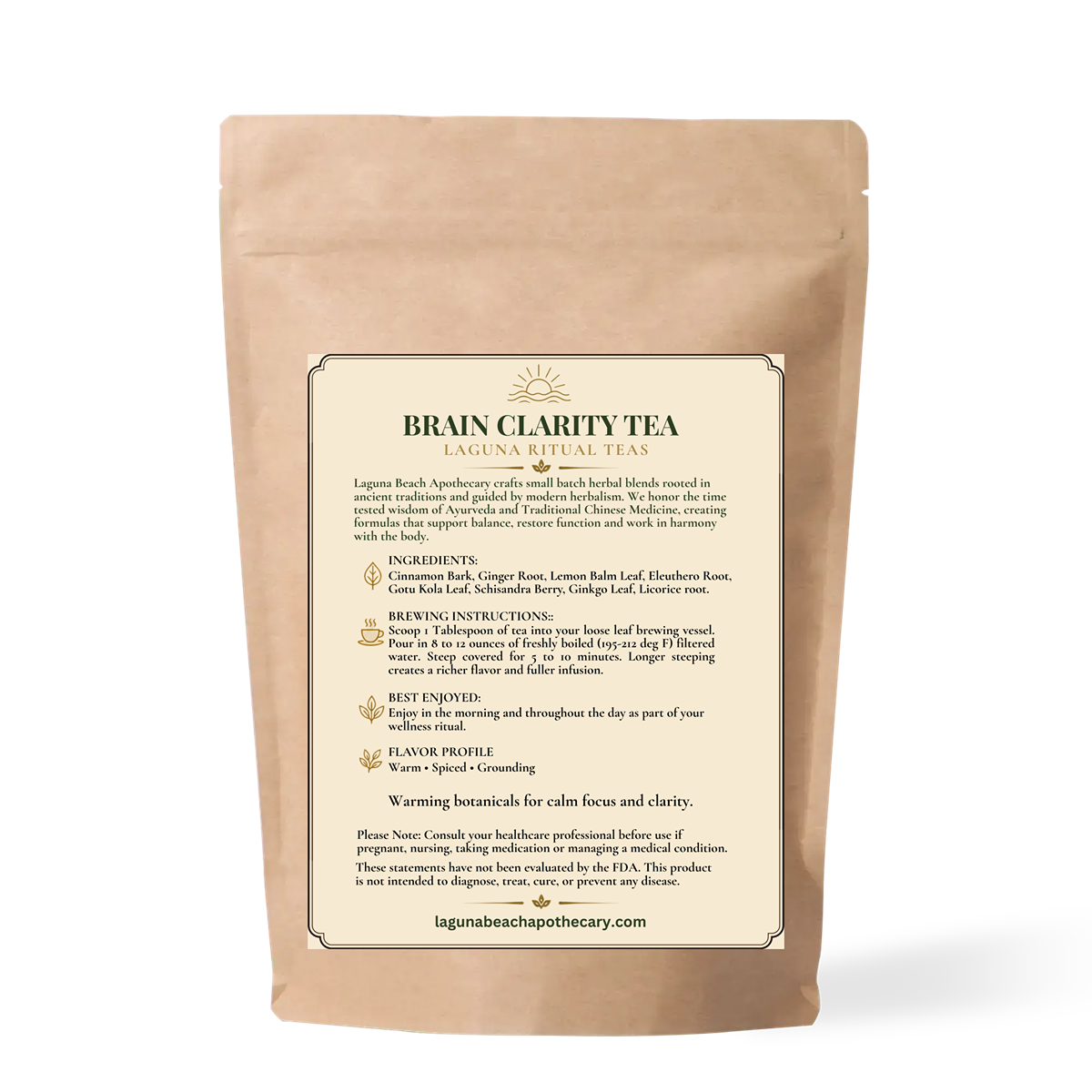

When clarity calls for something warmer
Brain Clarity Tea — Warm Spice Blend was created for those mornings when you want clarity with a little more warmth. Cinnamon and ginger bring more than their familiar warming character to the formula; both have a long history of traditional use and have been studied for their potential relationship with cognitive function, circulation, inflammation, and brain health. They join lemon balm, gotu kola, eleuthero, schisandra, ginkgo, and licorice to create a blend built around mental clarity, focus, memory, resilience, and nervous-system support.
Some of these plants have been used in herbal traditions for generations, while modern research continues to explore their relationship with cognitive function, circulation, stress adaptation, inflammation, and brain health. Rather than thinking of Brain Clarity as something to reach for only when you need to concentrate, we see it as a simple daily practice—one that gives you a way to care for your mind consistently over time.
The warm-spice blend offers a different expression of Brain Clarity from our peppermint version. Here, the warming herbs are part of the formula's purpose as well as its character, creating a deeper, rounder cup while bringing their own traditional and botanical qualities to the blend.
It is an inviting morning tea for beginning the day with clarity, focus, and intention.
Why These Herbs
Brain Clarity Warm Spice was built around the idea that mental clarity can come from more than one direction.
Cinnamon and ginger bring a warming, stimulating dimension to the formula, while their naturally occurring compounds have also attracted research interest for their antioxidant, anti-inflammatory, circulatory, and potential neuroprotective properties. They give the blend more than its distinctive warmth—they add another botanical perspective to the formula.
Lemon balm brings a softer relationship with the nervous system, traditionally valued for calm, mood, memory, and mental clarity. Gotu kola adds a restorative dimension, with a long history of use in connection with cognition, vitality, and the nervous system.
Eleuthero and schisandra bring adaptogenic herbs traditionally valued for resilience, endurance, and adapting to physical and mental demands. Ginkgo contributes another perspective, with its long history of use in connection with memory, circulation, and cognitive function.
Licorice root rounds out the formula, bringing natural sweetness along with its traditional role as a harmonizing herb that helps bring the qualities of a formula together.
Together, these eight herbs approach clarity from several directions—cognitive function, nervous-system balance, resilience, circulation, and the broader effects of oxidative stress and inflammation—rather than asking one plant to do everything.
The result is a warmer expression of Brain Clarity: a formula where each herb contributes something different, and where the whole becomes more interesting than any single ingredient alone.
The Herbs
-

Cinnamon Bark
Cognitive Support • Antioxidant • Anti-Inflammatory • Circulatory Support
-

Ginger Root
Cognitive Support • Anti-Inflammatory • Antioxidant • Circulatory Support
-

Lemon Balm Leaf
Anxiety and Stress Reduction • Memory and Alertness • Neuroprotection • Mood Support
-

Eleuthero
Mental Endurance • Resilience • Stress Adaptation • Neuroprotection • Focus
-

Gotu Kola Leaf
Memory and Cognition • Anxiety and Stress Reduction • Neuroprotection • Tissue Repair Support
-

Schisandra
Mental Endurance • Stress Adaptation • Focus • Memory Support
-

Ginkgo Biloba
Memory • Circulation • Cognitive Function • Antioxidant Support
-

Licorice Root
Anti Inflammatory • Antioxidant • Neuroprotection • Formula Harmonization


The Cup
The first impression is warm and aromatic. Cinnamon and ginger lead the cup with a gentle spice and a naturally warming character, while lemon balm adds a softer herbal note beneath them.
As the tea settles, the deeper herbs come forward. Gotu kola, eleuthero, and schisandra add subtle earthy and botanical depth, while licorice brings a gentle natural sweetness that rounds the edges. Ginkgo contributes another layer of herbal character without dominating the cup.
The result is a tea that feels warmer, deeper, and more rounded than our peppermint version. It has enough spice to feel invigorating, but remains smooth and balanced enough to become part of a quiet morning ritual.
Warm • Aromatic • Gently Spiced • Earthy • Naturally Sweet
A Closer Look
How to Brew
Scoop 1 tablespoon of tea into your loose-leaf brewing vessel.
Pour 8–12 ounces of freshly boiled, filtered water (195–212°F) over the herbs.
Steep covered for 10–15 minutes.
Because the blend contains cinnamon bark and ginger root, along with the softer leaves and berries, a longer steep allows the tougher plant material to release more fully into the infusion. Covering the vessel also helps retain the aromatic qualities and volatile oils of the herbs as they steep.
Strain and enjoy warm. A longer steep will create a fuller-bodied infusion with deeper spice and herbal character.
When to Enjoy
Brain Clarity Warm Spice can become part of a morning ritual whenever you want to begin the day with clarity, focus, and a little warmth. The combination of cinnamon and ginger makes it especially inviting first thing in the morning, while the cognitive and adaptogenic herbs give the blend a broader purpose than simply creating an energizing cup.
It can also be enjoyed before mentally demanding work, during an afternoon transition, or whenever you want to create a little space for focused attention.
Because the blend is naturally caffeine-free, it doesn't depend on stimulation to define the ritual. Instead, it offers a warm, aromatic way to pause, settle in, and give the mind some intentional attention.
Ingredients
Cinnamon Bark
Warm, aromatic, and naturally sweet, cinnamon has been valued in herbal traditions for generations. Its naturally occurring compounds, including cinnamaldehyde and polyphenols, have been studied for antioxidant and anti-inflammatory activity, as well as their relationship with circulation and metabolic health. In this blend, cinnamon brings both its warming character and another botanical dimension to the formula.
Ginger Root
Ginger brings a bright, warming quality to the blend, with a long history of traditional use for digestion and circulation. Its pungent compounds, including gingerols and shogaols, have attracted considerable research interest for their antioxidant and anti-inflammatory properties and their potential relationship with neurological and vascular health. Here, ginger helps create the deeper, more invigorating character of the warm-spice formula.
Lemon Balm Leaf
Soft, lemony, and aromatic, lemon balm has a long history of use for calm, mood, and mental clarity. Modern research has explored its relationship with memory, alertness, cognitive performance, and the nervous system. It gives the blend a gentler herbal quality that helps balance the warmth of the spices and deeper roots.
Eleuthero Root
Eleuthero has been used traditionally in East Asian herbal practice for stamina, endurance, and resilience in the face of physical and mental demands. Often described as an adaptogenic herb, it is valued for its relationship with the body's response to stress and exertion. In Brain Clarity Warm Spice, eleuthero adds depth and a broader sense of mental endurance to the formula.
Gotu Kola Leaf
Gotu kola has a long history of use in Ayurvedic and Asian herbal traditions, particularly in connection with memory, clarity, vitality, and the nervous system. Its naturally occurring triterpenes and other compounds continue to be studied for their antioxidant, cognitive, and tissue-related properties. It brings a restorative botanical quality to the blend.
Schisandra Berry
Schisandra is a distinctive berry traditionally used in East Asian herbal practice for endurance, resilience, and adapting to physical and mental demands. Its lignans and other naturally occurring compounds have been studied for antioxidant activity and their relationship with stress response and cognitive function. Its presence gives the formula both botanical depth and a subtle complexity of flavor.
Ginkgo Leaf
Ginkgo has one of the longest histories of traditional use among the herbs in this formula, particularly in connection with memory and circulation. Its leaves contain flavonoids and terpene compounds that have been extensively studied in relation to cognitive function and vascular health. In the blend, ginkgo contributes another perspective on clarity and circulation without dominating the cup.
Licorice Root
Licorice root brings natural sweetness and a smooth, rounded quality that helps bring the other herbs together. It has been used across many herbal traditions for generations, particularly for its soothing and harmonizing qualities. Its naturally occurring compounds, including glycyrrhizin and flavonoids, have also been studied for antioxidant and anti-inflammatory activity. In this formula, licorice helps soften the sharper edges of the spices while giving the finished infusion greater balance.
Caffeine
Naturally caffeine-free.
Brain Clarity Warm Spice contains no caffeinated tea leaves or other naturally caffeinated ingredients.
The blend's warming, aromatic character comes entirely from its herbs and spices—not from caffeine. Cinnamon and ginger give the cup a naturally invigorating quality, while the cognitive and adaptogenic herbs provide the broader character of the formula.
That makes it a versatile choice throughout the day, including in the afternoon when you want to avoid caffeine while still enjoying a warm, purposeful cup.
Flavor & Aroma
Flavor & Aroma
The aroma is warm and inviting, led by the familiar scent of cinnamon with the fresh, lively character of ginger just beneath it. Lemon balm adds a soft citrus-herbal note that keeps the spices from becoming too heavy.
The first sip brings gentle warmth rather than sharp spice. Cinnamon gives the infusion a naturally sweet, rounded character, while ginger adds a subtle brightness and warming finish. Beneath the spices, the deeper herbs contribute earthy and botanical notes, with schisandra adding a faint berry-like complexity and licorice bringing a gentle natural sweetness.
The longer the tea steeps, the fuller and more developed the cup becomes. It is warm without being overpowering, aromatic without being perfumed, and naturally balanced by the softer herbs and roots in the formula.
Warm • Aromatic • Gently Spiced • Earthy • Naturally Sweet
Herbal Research
The herbs in Brain Clarity Warm Spice belong to a much larger story than modern research alone can tell.
For thousands of years, people have turned to medicinal plants as part of the care of the body and mind. Long before individual compounds could be isolated or studied in a laboratory, herbalists learned through observation, tradition, and experience which plants were associated with memory, vitality, calm, endurance, digestion, circulation, and resilience.
Today, modern research is giving us another way to understand some of that botanical knowledge.
Cinnamon and ginger, for example, contain a wide range of naturally occurring compounds that have attracted considerable scientific interest. Cinnamon has been investigated for its relationship with memory and learning, while ginger has been studied in connection with memory, inflammation, circulation, and neurological function. A 2026 systematic review and meta-analysis of randomized controlled trials found a significant improvement in memory-related outcomes from Zingiberaceae-derived interventions, adding to a growing body of research surrounding ginger and related plants.
Lemon balm has a particularly interesting relationship with the purpose of this blend. Its aromatic compounds and polyphenols have been studied in connection with the nervous system, mood, memory, attention, and sleep. Human research has reported promising findings in several of these areas, while continuing research is helping to clarify how the plant's constituents may influence cognitive and neurological processes.
Gotu kola has a long history in Ayurvedic and Asian herbal traditions, where it has been valued for memory, clarity, vitality, and the nervous system. Modern research has begun investigating its triterpenes and other constituents in relation to cognition, antioxidant activity, neurological health, and tissue repair.
Eleuthero and schisandra bring another fascinating chapter to the story. Both have deep roots in East Asian herbal practice and have traditionally been valued for endurance, resilience, and the ability to adapt to physical and mental demands.
During the middle of the twentieth century, Soviet scientists took a particular interest in medicinal plants that might help the body adapt to demanding physical and mental conditions. This work helped helped develop and formalize the modern scientific concept of the adaptogen, and eleuthero and schisandra became two of the most extensively investigated plants in that tradition.
Eleuthero was incorporated into the Soviet pharmacopoeia in 1962 following years of research into stamina, endurance, work capacity, and adaptation to demanding conditions. Soviet researchers also investigated its relationship with mental performance and fatigue. A later review of previously untranslated Soviet research identified dozens of clinical studies examining eleuthero in areas including physical and mental endurance and cognitive function.
Schisandra followed a similar path. Although its roots are firmly established in traditional East Asian medicine, it became an important subject of Russian research and was recognized as an adaptogen in official Soviet medicine in the early 1960s. Russian scientists investigated its effects on endurance, attention, fatigue, and the ability to adapt to demanding physical and mental conditions.
Much of this early research was conducted using methods that would be evaluated differently by today's standards. But it represents an important chapter in the history of medicinal plants: traditional herbal knowledge was being brought into a modern research setting, and plants that had been used for generations were being examined through the emerging language of physiology and pharmacology.
Ginkgo brings yet another perspective. It is one of the most extensively studied medicinal plants in the formula, with research spanning circulation, oxidative stress, memory, and cognitive function. Its leaves contain flavonoids and terpene compounds that have been investigated for decades. Modern clinical research has produced different findings depending on the population and condition being studied, but the breadth of that research reflects the enduring scientific interest in this remarkable tree.
Licorice root contributes another layer. Its naturally occurring compounds have been studied for antioxidant, anti-inflammatory, and neurological properties, while traditional herbal systems have long valued licorice as a soothing and harmonizing plant—one that helps bring the qualities of a formula together.
What becomes interesting when we look at these herbs together is that they approach the idea of clarity from several directions.
Some have been studied in relation to memory and learning. Others have attracted interest for attention, circulation, oxidative stress, inflammation, or the nervous system. Several have traditional histories centered around resilience, vitality, and adaptation.
This is why we don't think of Brain Clarity Warm Spice as a formula built around a single “brain herb.”
It is a collection of medicinal plants with different histories, different chemistries, and different botanical personalities, brought together around a common purpose.
Modern science is still uncovering how these plants work, just as traditional herbalists have been learning from them for generations. Traditional knowledge gives us a long history of observation and practice; modern research gives us new tools for exploring the chemistry and physiology behind the plants.
The conversation between those two perspectives is still unfolding.
And perhaps that is one of the most compelling things about medicinal herbs: after thousands of years of human use, these remarkable plants continue to give us new questions—and new reasons to look more closely.
The Whole Herb
There is a reason we work with whole herbs rather than reducing a plant to a single isolated compound.
A plant is more than any one of its constituents. Its bark, roots, leaves, berries, and flowers contain a complex mixture of naturally occurring compounds that exist together within the plant. Modern research often isolates individual compounds so they can be studied more closely, and this has taught us an enormous amount about the chemistry of medicinal plants. But an isolated compound does not necessarily represent the full character of the plant from which it came.
The chemistry of a whole herb is remarkably complex. Different constituents can influence different biological pathways, and researchers are increasingly interested in how those compounds interact within the plant and within multi-herb formulas. Research into phytochemical synergy suggests that some constituents can work additively or synergistically, while others may influence absorption, metabolism, or the activity of neighboring compounds.
This complexity is one of the reasons traditional herbal practice has continued to work with whole plants for thousands of years.
Herbalists have always paid attention to more than the name of a plant. Which part of the plant is used? How is it prepared? How much is used? What qualities does it bring? And what happens when it is combined with other plants?
Brain Clarity Warm Spice reflects that way of thinking.
Cinnamon bark brings its aromatic oils and warming compounds. Ginger root contributes its pungent constituents and characteristic heat. Lemon balm leaf brings its fragrant volatile oils and softer botanical character. Gotu kola, eleuthero, and ginkgo contribute their own distinctive families of plant compounds, while schisandra berries bring their lignans and complex berry chemistry. Licorice root contributes its own compounds while also helping to harmonize the character of the formula.
None of these plants needs to do everything on its own.
A thoughtful herbal formula is not simply a collection of ingredients. It is a conversation between plants.
That doesn't mean the whole herb is always more effective than an isolated compound, or that every traditional use has been confirmed by modern research. It means that there is more to a medicinal plant than any single chemical within it, and that complexity is part of what makes herbal medicine so interesting.
We work with whole herbs because we value that complexity—and because there is still much to discover about the remarkable plants that have accompanied people throughout history.
With Brain Clarity Warm Spice, that philosophy becomes especially visible: bark, root, leaf, berry, and flower are brought together in one cup, each carrying its own history, chemistry, and character.
Traditional Use
The herbs in Brain Clarity Warm Spice come from several traditions of herbal medicine, each with its own way of understanding the relationship between plants, the body, and the mind.
Cinnamon and ginger have been used for generations throughout Asian and Middle Eastern herbal traditions. Ginger has traditionally been valued for its warming nature, digestion, circulation, and ability to bring movement and vitality to the body. Cinnamon has likewise been used as a warming aromatic herb, often included in formulas intended to support digestion, circulation, and overall vitality.
Lemon balm has a long history in European herbal medicine, where it was traditionally valued for the nervous system, mood, digestion, and emotional balance. Its lemon-scented leaves became associated with calming the mind while maintaining a sense of brightness and clarity.
Gotu kola has deep roots in Ayurvedic and South Asian herbal practice, as well as traditional medicine throughout parts of Asia. It has traditionally been associated with memory, concentration, longevity, vitality, and the nervous system. In these traditions, it has often been regarded as a restorative rather than simply a quick-acting herb.
Eleuthero and schisandra bring the traditions of East Asian herbal medicine into the formula. Schisandra, known in Chinese medicine as wu wei zi, or “five-flavor fruit,” has been used for more than two thousand years as a tonic associated with vitality, endurance, the lungs, digestion, and the preservation of strength.
Eleuthero has a long history of traditional use in Russia and East Asia as a tonic for vitality, endurance, and resilience. During the twentieth century, Russian and Soviet researchers developed particular interest in the plant's ability to help people meet physical and mental demands, eventually incorporating it into the emerging adaptogen tradition.
Ginkgo carries one of the oldest traditions represented in this blend. The tree has been used in Chinese medicine for centuries, with different parts of the plant traditionally associated with different purposes. Ginkgo leaf eventually became especially well known in modern herbal practice for its relationship with memory and circulation.
Licorice root has an equally long and widespread history. It has been used across Chinese, Ayurvedic, Middle Eastern, and European herbal traditions, both on its own and as part of complex formulas. Beyond its own traditional uses, licorice has often been valued as a harmonizing herb—one that helps bring other plants together while adding natural sweetness and a soothing quality to a formula.
These traditions are not identical, and we don't need to make them identical.
Each developed its own understanding of medicinal plants through generations of observation and practice. What they share is a recognition that plants can be used thoughtfully, in relationship with one another, and as part of a broader practice of caring for the whole person.
That history is part of what gives Brain Clarity Warm Spice its character today. The formula brings together plants from different botanical traditions, not to recreate any one traditional formula, but to carry forward the larger herbal principle that has guided plant medicine for thousands of years:
Learn the character of the plants. Understand how they work together. And use them with intention.