


Laguna Ritual Teas
Brain Clarity Tea - Peppermint
Brain Clarity Tea - Peppermint
Herbal support for clarity, focus and the nervous system
Couldn't load pickup availability


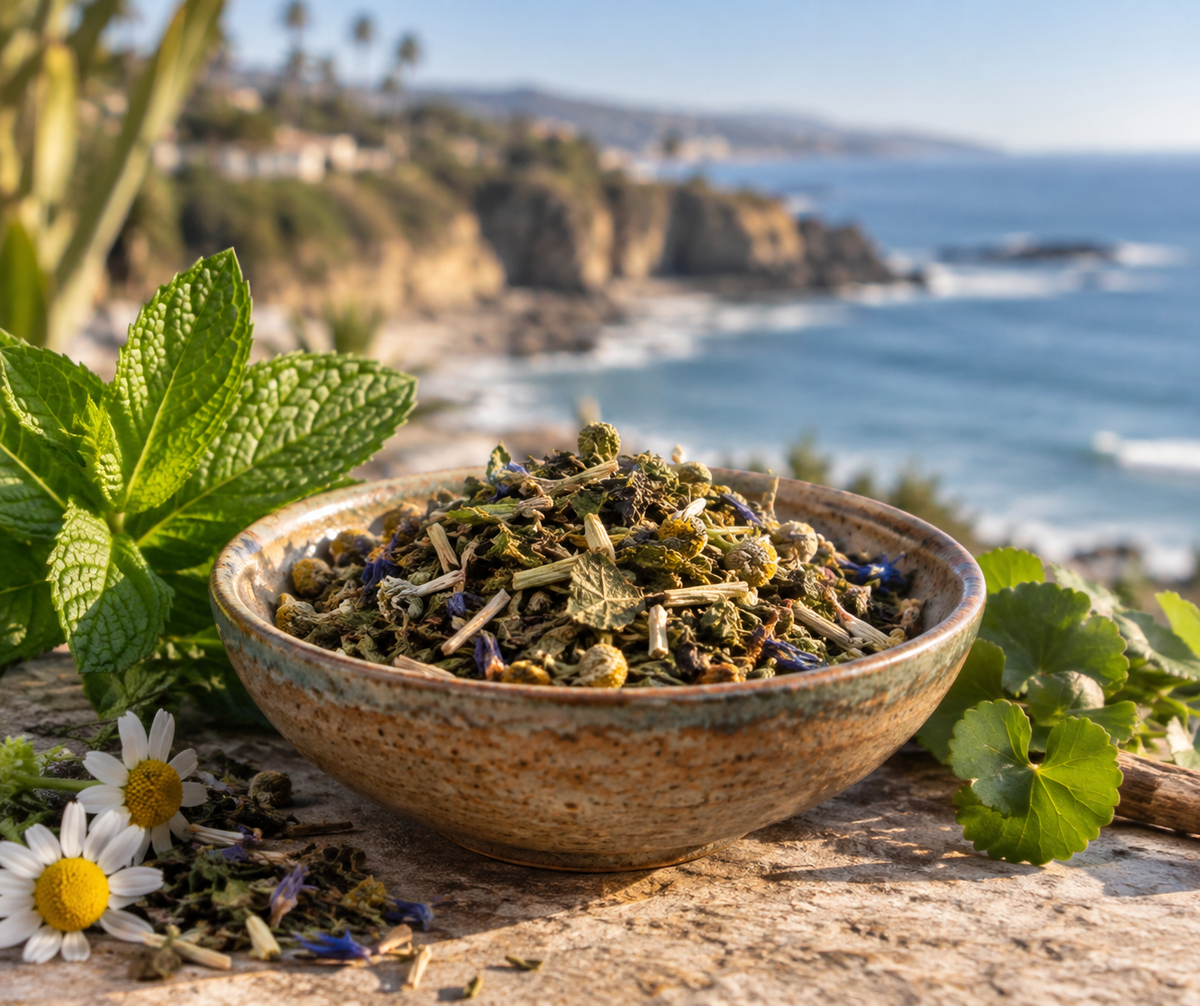
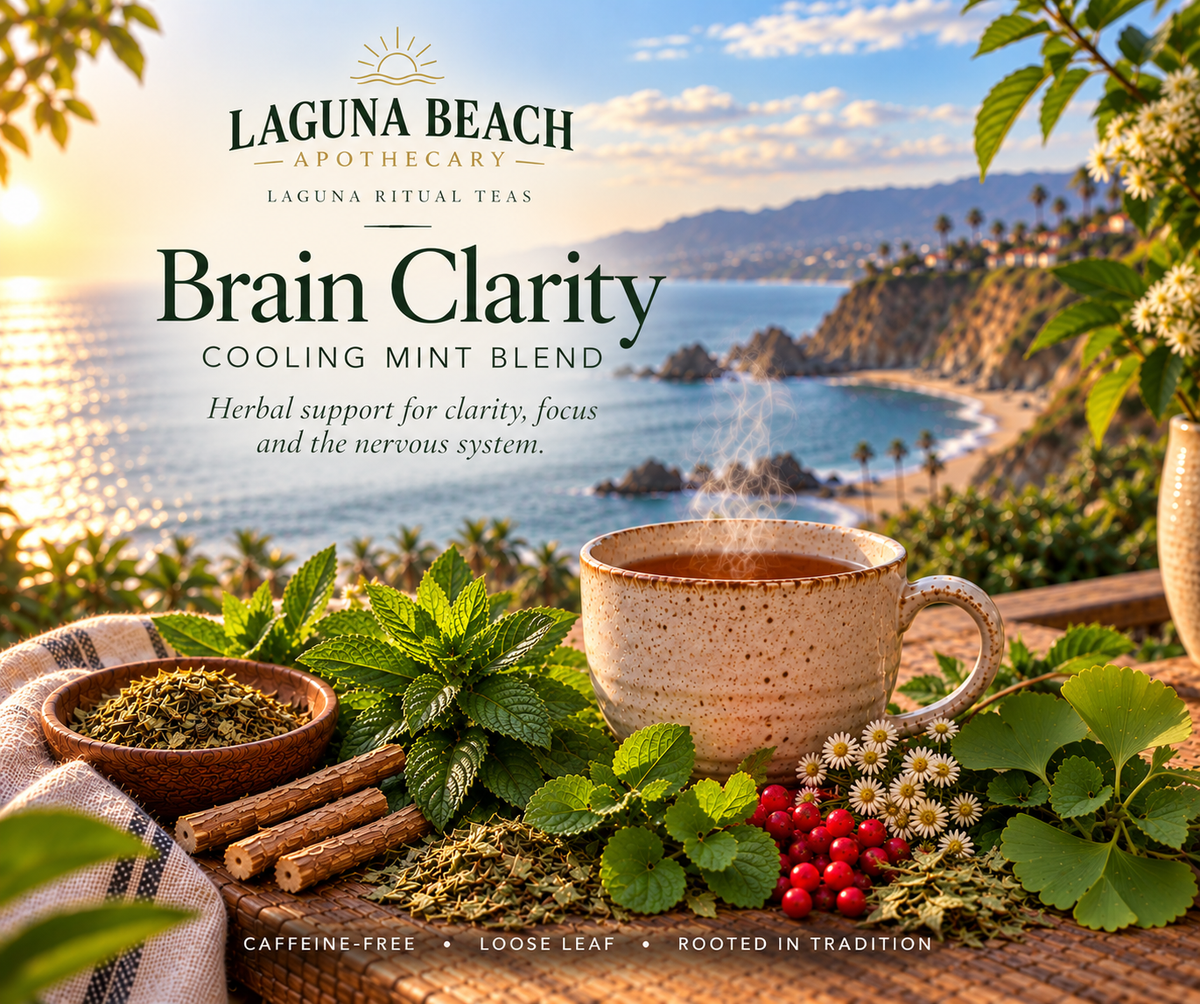

When the morning calls for clarity
Brain Clarity Tea was created for those moments when you want to clear the noise and bring a little more focus to the day. The blend brings together herbs traditionally valued for mental clarity, focus, memory, and nervous-system support.
Peppermint and lemon balm bring a fresh, uplifting character to the cup, while gotu kola, ginkgo, eleuthero, and schisandra have long histories of use in herbal traditions centered around the mind, resilience, and cognitive support. Licorice root rounds out the formula, bringing the herbs together in a naturally smooth, balanced blend.
Brain Clarity isn’t meant to be reserved for the moments when you need to concentrate most. We see it as a simple daily ritual—a refreshing cup you can return to in the morning or throughout the day, creating a consistent way to support clarity, focus, and an engaged mind.
Why These Herbs
Brain Clarity was built around the idea that mental clarity can come from more than one direction.
Peppermint and lemon balm create the bright, aromatic foundation of the blend, with traditional associations with alertness, mood, digestion, and nervous-system balance. Gotu kola brings a restorative dimension and a long tradition of use in formulas for the mind, while eleuthero and schisandra contribute adaptogenic support, traditionally valued for resilience, endurance, and the ability to adapt to physical and mental demands.
Ginkgo adds another dimension, with its long history of use in connection with memory and healthy circulation. Licorice root rounds out the formula with natural sweetness and its traditional role as a harmonizing herb.
Together, these seven herbs approach clarity from several directions—supporting the mind, nervous system, and resilience rather than asking a single plant to do everything.
The Herbs
-

Peppermint Leaf
Mental Clarity • Alertness • Digestive Support • Refreshing Aromatic
-

Lemon Balm Leaf
Calm Focus • Nervous System Support • Mood Support
-

Gotu Kola Leaf
Memory Support • Mental Clarity • Nervous System Support • Restorative Tonic
-

Eleuthero Root
Adaptogenic Support • Mental Endurance • Resilience • Stress Adaptation
-

Schisandra Berry
Adaptogenic Support • Mental Endurance • Focus • Resilience
-

Ginkgo Leaf
Memory Support • Cognitive Support • Healthy Circulation • Antioxidant Support
-

Licorice Root
Adaptogenic Support • Digestive Support • Restorative Tonic • Formula Harmonization


The Cup
The flavor is fresh and cooling without being sharp, with a gentle sweetness from licorice root that rounds the edges. Peppermint leads the cup with its crisp, aromatic character, while the remaining herbs create a smooth, balanced finish.
It is an easy cup to return to throughout the day—refreshing in the morning, welcome during focused work, and equally suited to those moments when you simply want to clear a little space for the mind.
A bright, aromatic tea with a cooling finish and gentle natural sweetness.
A Closer Look
How to Brew
Scoop 1 tablespoon of Brain Clarity Herbal Tea into your loose-leaf brewing vessel.
Pour 8–12 ounces of freshly boiled, filtered water (195–212°F) over the herbs.
Steep covered for 10–15 minutes.
Brain Clarity combines aromatic leaves with berries and roots. A covered infusion gives the denser botanicals time to infuse while helping retain the fresh aromatic qualities of peppermint and lemon balm.
Strain and enjoy warm.
For a lighter, brighter cup, stay toward the shorter end of the steeping time. For a deeper infusion, allow it to steep a little longer, giving the roots, berries, and leaves more time to release their naturally occurring botanical constituents into the water.
One tablespoon • 8–12 oz water • 10–15 minute steep
When to Enjoy
Brain Clarity Herbal Tea can be enjoyed whenever you want to support a clear, focused state of mind. It is especially fitting in the morning, before mentally demanding work, while studying or reading, or during the afternoon when attention begins to fade.
Because the blend is naturally caffeine-free, it offers another option for moments when you want a refreshing, focused ritual without relying on caffeine.
Brain Clarity was created to become part of a consistent daily practice rather than something reserved only for demanding days. Enjoy a cup whenever you want to pause, reset, and bring your attention back to what is in front of you.
Ingredients
Peppermint Leaf — Mentha × piperita — Leaf
A bright, aromatic herb traditionally valued for digestive comfort, mental clarity, and its refreshing, cooling qualities.
Lemon Balm Leaf — Melissa officinalis — Leaf
A gentle aromatic herb traditionally used to support calm, mood, digestion, and the nervous system.
Eleuthero Root — Eleutherococcus senticosus — Root
An adaptogenic root traditionally valued for resilience, stamina, and supporting the body's response to physical and mental demands.
Gotu Kola Leaf — Centella asiatica — Leaf
A restorative herb with a long tradition of use for memory, mental clarity, and nervous-system support.
Schisandra Berry — Schisandra chinensis — Fruit
An adaptogenic botanical traditionally valued for resilience, endurance, concentration, and overall vitality.
Ginkgo Leaf — Ginkgo biloba — Leaf
Traditionally valued for memory and cognitive support and its relationship with healthy circulation.
Licorice Root — Glycyrrhiza glabra — Root
A naturally sweet root traditionally valued for digestive and restorative support and widely used as a harmonizing herb in herbal formulas.
Caffeine
Naturally caffeine-free.
Brain Clarity Herbal Tea contains no caffeinated tea leaves or other naturally caffeinated ingredients.
Unlike many beverages associated with focus and mental clarity, Brain Clarity does not rely on caffeine or other stimulants as the foundation of the blend. Instead, its character comes from a thoughtful combination of herbs traditionally associated with clarity, resilience, and nervous-system support.
This makes it a versatile choice throughout the day, including the afternoon when you may want to stay engaged without adding more caffeine to your routine.
Flavor & Aroma
Fresh, minty, and gently sweet, with a clean peppermint aroma and soft herbal notes from lemon balm. Schisandra brings a subtle tartness, while the roots and deeper botanicals add a mild earthy character beneath the brighter mint.
Licorice root adds a smooth, natural sweetness that rounds the blend and creates a balanced finish without overpowering its fresh, cooling character.
Herbal Research
Brain Clarity brings together plants with long histories of traditional use and an intriguing range of modern research. Researchers have explored these herbs in relation to attention, memory, mood, mental fatigue, stress adaptation, circulation, and neurological function.
What makes the research particularly interesting is that these plants approach mental clarity from different directions. Some have been investigated in human clinical trials, while others are better understood through their traditional use, plant chemistry, and laboratory research. Together, they offer a fascinating look at the many ways plants traditionally associated with the mind are being examined by modern science.
Peppermint
Peppermint is more than the bright, refreshing herb that opens the cup. Its aromatic compounds have long attracted scientific interest in connection with alertness, attention, and cognitive performance.
Research has included studies of peppermint aroma and preparations, and more recently peppermint tea itself. In a small randomized placebo-controlled human study, researchers found differences in cognitive performance and measures of cerebral blood flow after participants consumed peppermint tea.
The study adds an interesting modern dimension to a plant traditionally appreciated for its ability to awaken the senses—and brings the research particularly close to the way peppermint is enjoyed in Brain Clarity: as an infusion.
Lemon Balm
Lemon balm has attracted considerable research interest for its relationship with mood, stress, attention, and memory.
Human randomized trials using lemon balm preparations have examined cognitive performance, attention, calmness, and responses to mentally demanding tasks. Research published in 2026 continued this work, examining lemon balm extract in healthy adults experiencing cognitive overload and finding differences in some of the most demanding executive-function tasks as well as recovery of calmness following cognitive effort.
The findings vary according to preparation, dose, and study design, but they reinforce an intriguing idea behind this formula: mental clarity does not necessarily have to come from stimulation. A calmer mental environment may also create space for attention.
Gotu Kola
Gotu kola (Centella asiatica) has a long history in Ayurvedic and other Asian herbal traditions, where it has been valued as a restorative herb associated with the mind.
Modern researchers have investigated naturally occurring constituents including asiaticoside, madecassoside, and asiatic acid in relation to antioxidant activity, neuronal function, and neuroprotective pathways. Human studies have also explored gotu kola in connection with cognition, alertness, and mood.
A systematic review of clinical research found that evidence for broad cognitive improvement remains limited, while identifying interesting findings involving alertness and mood. The research continues to add another layer to a plant whose traditional relationship with memory and the mind extends back centuries.
Eleuthero
Eleuthero (Eleutherococcus senticosus) has one of the most unusual modern research histories in the formula.
Beginning in the Soviet era, researchers became intensely interested in plants that might help the body adapt to demanding conditions. Eleuthero was investigated in relation to physical and mental stamina, fatigue, work capacity, endurance, and performance under environmental stress.
A modern review recovered 46 Soviet human studies conducted between 1962 and 1986, offering researchers a rare look into decades of work that had previously been difficult to access outside the former Soviet Union.
The quality and methods of those early studies varied, and later research has continued to refine our understanding of the plant. But the question that drove much of that work remains fascinating today:
How does the human body adapt when ordinary demands become extraordinary?
That question is at the heart of why eleuthero remains an important adaptogenic herb and why it has a place in a formula centered around mental stamina and resilience.
Schisandra
Schisandra (Schisandra chinensis) has been valued for centuries in traditional East Asian herbal practice and is one of the more chemically complex plants in Brain Clarity.
Its naturally occurring lignans and other constituents have been investigated for antioxidant activity and their relationship with cellular stress responses and neurological pathways. Experimental research has also explored schisandra in connection with learning, memory, neuronal function, and adaptation to physiological stress.
Much of this work remains experimental, but it provides a fascinating scientific perspective on a plant traditionally valued for endurance, vitality, concentration, and resilience.
Ginkgo
Ginkgo (Ginkgo biloba) may be the most recognizable plant in the formula when it comes to memory and cognition—and it is also one of the most extensively researched.
Ginkgo leaves contain flavonoids and terpene lactones that have been studied in relation to antioxidant activity, circulation, and neurological function. Standardized ginkgo extracts have been investigated in human studies involving memory and cognitive function across different populations.
Results vary considerably depending on the population, preparation, and outcome being studied. That complexity is part of what makes ginkgo's research story so interesting. Rather than a simple “memory herb,” it is a chemically complex plant that continues to be studied from several different perspectives.
Licorice Root
Licorice (Glycyrrhiza glabra) has been used across numerous herbal traditions and has a particularly long history as a harmonizing plant within multi-herb formulas.
Its naturally occurring constituents include glycyrrhizin and numerous flavonoids that continue to be investigated for antioxidant, inflammatory, and neurological pathways.
Within Brain Clarity, licorice also serves a very practical purpose. Its natural sweetness softens the brighter peppermint and deeper roots and berries, helping seven very different botanicals come together as one balanced cup.
The Formula as a Whole
The most interesting thing about Brain Clarity may not be any single herb.
The formula brings together aromatic herbs, restorative botanicals, adaptogenic plants, berries, roots, and leaves with very different histories and phytochemical profiles. Modern research gives us one way of examining them. Traditional herbal knowledge gives us another—built from generations of observing how plants were prepared, combined, and used.
Brain Clarity sits at the intersection of those two perspectives.
It is a formula grounded in traditional herbal knowledge, informed by modern botanical research, and built around a simple idea: supporting the mind can be part of an everyday ritual rather than something reserved only for the moments when greater focus is demanded.
The research continues—and with it, our understanding of these remarkable plants continues to grow.
The Whole Herb
There is a reason we work with whole herbs rather than reducing a plant to a single isolated compound.
A plant is more than any one of its constituents. Its leaves, roots, flowers, and seeds contain a complex mixture of naturally occurring compounds that exist together within the plant. Modern research often isolates individual compounds so they can be studied more closely, and this has taught us a great deal about the chemistry of medicinal
plants. But an isolated compound does not necessarily represent the full
character of the plant from which it came.
The chemistry of a whole herb is remarkably complex. Its constituents may interact with one another and contribute different qualities to the overall activity of the plant. Some
compounds may influence absorption or metabolism, while others contribute to
the plant's antioxidant, aromatic, or physiological properties. We are still
learning how much of that complexity matters.
This is one reason traditional herbal practice has continued to work with whole plants for centuries. Herbalists have observed not only individual plants, but also which part of the plant is used, how it is prepared, how much is used, and what happens when different plants are brought together in a formula.
Traditional Use
Long before the language of cognitive performance, neurotransmitters, or stress physiology existed, herbal traditions had their own ways of thinking about the mind.
Rather than separating memory, concentration, mood, digestion, energy, and resilience into entirely different categories, traditional herbal systems often viewed them as interconnected. A clear mind was understood in the context of the whole person.
Brain Clarity brings together plants from several of those traditions.
Gotu kola has a particularly deep relationship with the mind. Known as mandukaparni in Ayurveda, it has traditionally been used as a medhya rasayana—a category of restorative herbs associated with memory, intellect, and mental vitality.
Schisandra has a long history in Traditional Chinese Medicine, where the fruit is known as wu wei zi, or “five-flavor fruit.” Traditionally regarded as a strengthening and conserving herb, it was used in formulas associated with vitality, endurance, and maintaining balance during periods of demand.
Ginkgo comes from one of the oldest surviving tree species on Earth. Its leaves have a history of use in Chinese herbal practice, while its modern association with memory developed much later as European phytotherapy began studying standardized preparations of the leaf.
Eleuthero also comes from the herbal traditions of East Asia, where the root has been valued as a strengthening tonic. Its traditional identity centered less on creating immediate stimulation and more on supporting stamina and resilience over time.
European herbal traditions bring another dimension to the formula. Lemon balm was traditionally valued as a calming, uplifting aromatic herb, while peppermint became widely used for its refreshing character and its relationship with digestion and the senses.
And then there is licorice root—a plant with an unusually broad history across both Eastern and Western herbal traditions. Beyond its own traditional uses, licorice has often been included in multi-herb formulas to soften, balance, and harmonize the character of other plants.
Seen through this traditional lens, Brain Clarity begins to look less like a collection of individual “brain herbs” and more like something herbalists have understood for generations:
The mind does not exist separately from the rest of the body.
Clarity can be approached through calm as well as stimulation, through resilience as well as concentration, and through consistent nourishment rather than waiting until mental energy feels depleted.
Brain Clarity carries that older herbal philosophy into a modern daily ritual—seven plants from different traditions, brought together around the simple practice of caring for the mind.